
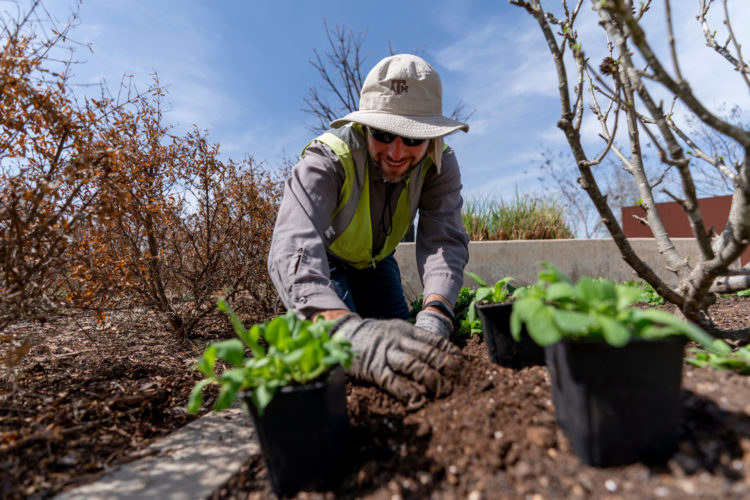
The Gardens regularly completes both routine and major maintenance projects through partnerships with various departments and organizations. Check out some of our past, current, and future projects below!
Past Projects
Winter storm Uri (Feb. 2021) and other extreme weather conditions had unfortunately led to the decline and death of several post oaks in the Leach Teaching Gardens Event Lawn Area. These tree were removed from the Event Lawn due to the resulting safety hazard they present. The Gardens team replaced the lost trees with displaced trees from the resigned Horticultural Gardens on Hensel Dr.
The students in HORT 425 (Horticulture Landscape Installation) will be renovating the weary wildflower/prairie grass area to a more manageable native landscape in the Homestead Garden as part of a class project. The plant pallet will consist of native and ornamental grasses, resilient shrubs, and naturalized bulbs that are commonly found on abandoned homestead sites. The new plantings will also add additional plant identification material to teach from.
Homestead Garden Area Renovation Design
Current Projects
The Leach Vineyard reflects our state’s long history of grape growing and research. In early spring 2026, vineyard renovations include soil remediation and the incorporation of nutrients to support healthy grapevine growth, and new Champanel grapevines will be planted. The Champanel grape, developed in 1893 by Texas viticulturist Thomas V. Munson, resembles the Concord grape in appearance and flavor but is better adapted to Texas growing conditions. It is also a Pierce’s Disease–tolerant hybrid cultivar, making it well suited for long-term success in the region.
Did you know that wildflower seeds actually get planted in the fall? We are currently in the process of prepping our wildflower and prairie grass areas for seeding here in the next couple of months. We hope you’ll come visit us next spring when they are in full bloom!
In early spring 2026, construction will begin on The Sarah A. ’84 and Mark A. Philpy ’77 SEED Garden (Supporting Experiential Education and Demonstrations). The mission of The Gardens at Texas A&M University is to engage the community in a living teaching environment, foster curiosity, and discovery, and inspire wonder for the natural world. The SEED Garden will further advance this mission by providing a versatile, multi-use space for educational programming for all ages, along with dedicated areas for gardening, landscaping, and sustainability demonstrations. The primary objective of the SEED Garden is to expand instructional capacity by adding garden beds and flexible learning spaces for programs hosted by The Gardens. This project will transform the site from an underutilized turfed area into a functional extension of the Leach Teaching Gardens, creating an enhanced setting for hands-on learning and demonstration.
A tree protection zone has been established around the 200-year-old Post Oak, (Quercus stellata), known as Ol’ Sarge. To put its age into perspective, Ol’ Sarge was already 60 to 80 years old when Texas A&M was founded in 1876. The protection zone was created to help preserve the tree’s health and safety of visitors. Over time, some dead branches developed in the canopy, and a large limb was damaged during a severe windstorm, resulting in a four-foot crack. To address these concerns, deadwood was carefully removed, and support cables and braces were installed to stabilize the affected branch. The protection zone remains in place to allow the tree to continue healing and to protect its sensitive root system from disturbance. Post Oaks are especially vulnerable to changes in their environment and limiting activity beneath and around the tree helps ensure that Ol’ Sarge can be enjoyed for generations to come. As a native tree species in our region known as the Post Oak Savannah, Post Oaks are slow-growing and well adapted to challenging conditions. They commonly thrive in dry areas along field edges, on ridge tops, and in poor soils, and are naturally resistant to rot, fire, and drought, traits that have helped Ol’ Sarge endure for centuries.